Deposit help / Ireland · EUR
Online Casino Fast Payout: What Actually Sets the Clock in Ireland
 Best casinos available in IrelandUpdated 7 November 2026



An online casino fast payout is never one number. It is a review window at the operator plus a settlement window at your payment provider, and the two are decided by completely different people. In Ireland the quickest routes are normally an instant bank rail or a wallet already registered in your own name, while a standard transfer still runs on working days; finish verification before you ever press withdraw and most of the waiting disappears.
What an online casino fast payout actually measures
Comparison tables love the word instant, but the clock starts long before any money moves. When you confirm a withdrawal, the request joins a queue: the payments team checks that the account is verified, that the balance is withdrawable rather than bonus-locked, and that the money is going back to a method held in your own name. Only after that approval does the payment leave the operator, and only then does the rail you picked decide how long the last leg takes.
That is why two casinos can both advertise same-day cash-outs and behave nothing alike. One approves in minutes and pays to a wallet. The other approves in minutes and pays by standard transfer, which then sits in the banking system across a weekend. The figure worth hunting for is not an average but a pair of windows: how long the review takes, and how long your chosen route needs after approval.
Treat a promise with no stated window as missing information rather than good news. A cashier line saying a method is processed immediately after authorisation describes the rail. A help page saying requests are reviewed inside a stated number of hours describes the queue. You need both before the word fast means anything. Read them against the operator's own withdrawal timings page instead of a third-party league table, because the table is written once and the cashier is updated when limits change.
The three clocks behind every withdrawal
Splitting the wait into three parts tells you who can actually fix a delay. Players tend to blame the casino for all of it, then discover the money was released hours ago and is waiting on a bank posting run.
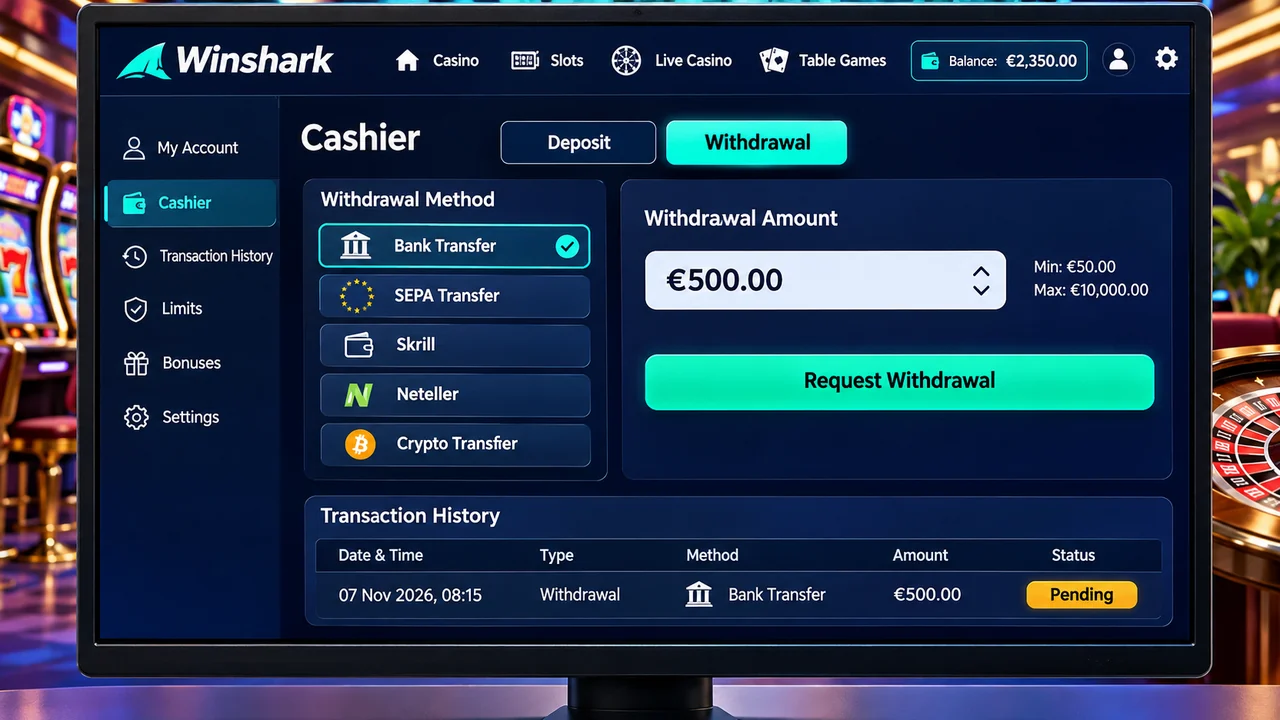
- The review clock runs from the moment you confirm the request until the payments team approves it. Verification gaps, unfinished wagering and a mismatch between the deposit method and the withdrawal method all live here. This part is entirely inside the operator's control, so it is the part a help page should put a number on.
- The rail clock runs from approval until your provider shows the funds. An instant bank scheme or a verified e-wallet can finish it in seconds or minutes. A card refund and a standard euro transfer are measured in working days, because they ride on batch processing rather than real-time messaging.
- The availability clock runs from your provider receiving the money until you can spend it. Some Irish banks post an incoming credit the moment it lands; others hold it as pending until the next posting cycle, which is why an app can show a payment and a balance that has not changed yet.
Most complaints about a slow casino are really complaints about clocks two and three. If the cashier shows the request as completed and the money is not visible, the trace belongs with the payment provider; the operator can only hand you the transaction reference. That is also the order in which support will ask you to check, so checking it first saves a round of messages. The site's withdrawal problems guide follows the same sequence.
Irish payout routes and how each rail settles
Ireland is a euro market with an unusually high share of app-first banking, so the gap between the fastest and slowest route is wider here than the single phrase bank transfer suggests. Two payments can both be called a transfer and travel on completely different schemes.
| Route | How it behaves | What decides the speed | Where to check the detail |
|---|---|---|---|
| Instant bank transfer or pay-by-bank | Designed as a real-time credit, so the settlement leg is measured in seconds once released | Whether your bank supports the instant scheme for incoming credits, and whether the operator routes payouts through it at all | The cashier method screen and the pay by bank guide |
| Verified e-wallet | Usually the shortest rail after approval, because the wallet account is credited directly | Whether the wallet is already verified and registered in the same name as the casino account | The wallet app plus the operator's method list |
| Revolut and similar app accounts | Often behaves like an instant credit for incoming payments | Whether the payout is sent as a transfer to the account details or as a card refund, which are different rails | The Revolut withdrawals page |
| Debit card refund | Returns to the card used for the deposit and follows card-scheme processing | Card issuer posting cycles, not the casino; a refund is not a purchase and can post later than one | The debit card guide and your card app |
| Standard euro bank transfer | Batch processing on working days only | Daily cut-off time, weekends and public holidays, plus the reference matching at both ends | The bank transfer guide |
| Wallet-linked services such as PayPal | Credit to the wallet balance is normally quick; moving it onward to a bank is a second journey | Whether you count the payout as arriving in the wallet or in your current account | The PayPal page |
One practical consequence: the fastest route is rarely the one you are offered by default. Cashiers often pre-select the method you deposited with, because returning funds to source is a standard anti-fraud rule. If the quickest available rail is a different one, you may have to deposit with it once before it becomes a valid withdrawal target. That is a decision to make before a win, not after.
Finish verification while your balance is still small
The single biggest cause of a slow first payout is identity checking that starts only when money is leaving. Operators licensed in regulated European markets have to confirm who holds the account, and the request usually covers three things: who you are, where you live, and that the payment method belongs to you. None of that is unusual, but all of it takes a human review pass.
What a verification request normally covers
- Proof of identity: a photo document that is in date, fully in frame and readable at the corners, because a cropped edge is the most common reason for a resubmission.
- Proof of address: a document showing the same name and address as the account profile. If you moved and updated the bank but not the casino profile, the two will not match.
- Proof of the payment method: a statement or card image that shows the account holder's name, usually with the middle digits covered.
- Source-of-funds questions, which appear at higher amounts and are a licensing requirement rather than a sign of suspicion.
Doing this on day one costs you ten minutes and removes a day or more from the first withdrawal. Doing it during a payout means the review clock cannot even start until a reviewer has seen your documents, and reviewers work in business hours. Keep the name on the casino account identical to the name on the bank account, including the form of your first name, and keep one document set ready so a resubmission is a two-minute job rather than a new search.
There is a second benefit that rarely gets mentioned. A verified account is also the account that can raise its own limits, because many cashiers apply a lower cap to unverified profiles. The checks you did for speed end up removing the part-payment problem described below.
Limits, part-payments and a win that arrives in slices
A casino can be genuinely fast and still take a week to pay you, because speed and capacity are separate settings. Most cashiers publish a per-request maximum, a daily maximum and sometimes a weekly or monthly one. When a win is larger than the cap, the payout is split: the first slice goes out at full speed and the rest queues behind the next window.
This is where the word instant does the most damage. If the daily ceiling is lower than your balance, the honest answer to how fast can I get my money is a division sum, not a time. Divide the balance by the daily cap and you have the number of days, regardless of how quickly each individual slice settles.
Two details are worth reading in the terms before you deposit. First, whether the cap applies per request or per calendar day, because a per-request cap with no daily limit lets you submit several in a row. Second, whether a cancelled withdrawal returns to the playable balance; if it does, a cancelled request is how a large win quietly becomes a smaller one. A cashier that shows the remaining allowance for the current period is doing you a favour, and it is worth checking that figure before you plan a cash-out schedule.
Fees are a separate question from speed
Fast and free are not the same claim. An operator may state that it applies no charge of its own while your provider still applies a currency conversion or an outgoing payment fee. If the balance is in euro and the destination account is in euro, conversion should not arise; if either side is not, check which party sets the rate. Ask the question in the cashier, where the method screen shows current charges, rather than relying on a general help article.

A worked example: one payout, two stages
The numbers below are an example only, chosen to show how the arithmetic works. Use the caps and windows displayed in your own cashier, because they differ by operator, by method and sometimes by account level.
Assume a balance of 1,200 euro, a cashier that shows a daily withdrawal ceiling of 500 euro, a review window stated as up to twelve hours, and an instant bank rail for the settlement leg. Day one: you request 500 euro. The review clock runs, approval lands inside the stated window, and the rail credits the account within minutes of release. Day two: the second 500 euro follows the same path. Day three: the final 200 euro goes out. Total elapsed time is about three days, even though every individual payment settled in minutes.
Now change one variable. Replace the instant rail with a standard transfer and start on a Friday. The reviews still complete quickly, but each released payment waits for the next working-day batch, so the first slice may land on Monday and the last one later in the week. Nothing about the casino changed; the rail did. This is exactly why a single advertised figure cannot describe a payout, and why the method screen matters more than the marketing line.
The useful takeaway is an order of operations: verify first, pick the rail second, then size the request against the published cap. Reversing that order is what produces the week-long wait people describe as a slow casino.
Cut-offs, weekends and Irish public holidays
Every batch-based payment scheme has a daily cut-off, and a request that misses it is not late in the way a delayed train is late: it simply belongs to the next cycle. Submit a standard transfer in the evening and the clock you care about starts the following working morning. Submit it before a weekend and the settlement leg skips two days.
Ireland adds its own calendar to that. Public holidays here do not all line up with the rest of the euro area, so a day that is a normal business day for a payment processor based elsewhere can still be a non-posting day at an Irish bank. February, March, May, June, August and October all carry a Monday holiday in the Irish calendar, and the early-year cluster around Christmas and New Year closes several consecutive days.
Instant rails and wallets are largely indifferent to this, which is the real argument for choosing them. If you only have access to a batch route, the practical move is to submit early in the day and early in the week. It changes nothing about the operator's review speed and can still remove two or three days from the total.
What quietly slows a payout that should be instant
When a withdrawal that ought to be quick is not, the cause is nearly always one of a short list. Working through it takes a few minutes and saves a support exchange that costs a day.
- The account is not fully verified, or a document was accepted for one purpose and is now out of date for another.
- Part of the balance is bonus money with wagering still outstanding, so only the cash portion is withdrawable and the request was reduced or held.
- The withdrawal method is not the deposit method, and a return-to-source rule is routing part of the payment back to the original card.
- The name on the receiving account differs from the account profile, including a shortened first name or a missing second surname.
- The request exceeded the per-request cap and was split, so the cashier shows one payment completed and another pending.
- A deposit is still clearing. Many operators will not release funds that originate from a payment which has not fully settled.
- The request was submitted after the daily cut-off for a batch rail, so the release looks delayed when it is simply in the next cycle.
Note what is not on that list: playing the wrong game, cashing out too often, or any pattern that a help page would describe as penalised. If you are told a payout is held for a reason you cannot find in the terms, ask for the clause. A licensed operator has to be able to point at the rule it is applying, and the written rule is the only version worth arguing with.

Test a cashier's payout speed in one cycle
You do not need a big win to find out how fast a casino pays. One small, complete cycle tells you more than any review score, because it exercises every clock in order and leaves you with timestamps instead of impressions.
- Verify the account before depositing anything. If the operator will not accept documents until a deposit exists, that answer is itself a finding.
- Deposit the minimum with the method you intend to withdraw to, so return-to-source rules cannot reroute the payout.
- Play without a bonus for the first cycle. A bonus adds wagering conditions that will mask the payout speed you are trying to measure.
- Request a small withdrawal and write down the exact time you confirmed it.
- Note the timestamp when the cashier status changes from pending to approved or processed. That difference is the review clock.
- Note the timestamp when the funds appear in your provider, then when they become available to spend. Those are the rail and availability clocks.
- Repeat once on a different day of the week. A single weekday test can flatter a cashier that has no weekend processing.
Keep the three numbers. They are the only payout data about that operator that is actually about you, your bank and your verification state, and they remain valid long after a published comparison has gone stale. Start the whole exercise from the operator's payment methods page so you are testing a route it currently supports in Ireland.
Bonus balance: the wager that holds the cash
The last common reason a fast cashier looks slow has nothing to do with payments. If you accepted an offer, the balance is usually split into cash and bonus parts, and the bonus part is not withdrawable until its wagering condition has been met. Request a payout before that point and the cashier will either reduce the amount to the cash portion or refuse the request and explain that a bonus is active.
Two mechanics do most of the damage here. The first is game contribution: not every title counts the same percentage of a stake towards the requirement, and some are excluded entirely, so a session can feel productive and move the counter barely at all. The second is the maximum stake allowed while a bonus is running. Exceed it and the offer can be voided under the terms, which turns a payout question into a dispute. Both values are written in the offer terms rather than the cashier.
If what you want is speed, the clean answer is to take the first cycle without an offer. A no-bonus balance is entirely cash, so the review clock is the only operator-side delay and there is nothing for the terms to hold. Accept offers later, once you already know how the cashier behaves and how long each clock actually runs. Gambling is an adult activity with a real cost: set a budget you can lose before you deposit, and treat any payout as the end of a session rather than the start of a bigger one.
Fast payout questions, answered straight
Which withdrawal method is genuinely the fastest in Ireland?
After the operator approves the request, an instant bank rail or an already-verified e-wallet normally finishes fastest, because both are real-time credits rather than batch payments. A standard euro transfer and a debit card refund are the slowest, since they depend on posting cycles that do not run at weekends. Whichever one you pick, the review stage at the casino happens first and is not affected by the rail.
Why does a casino show my withdrawal as completed when the money is not there?
Completed in a cashier means the payment has been released, not that your bank has posted it. The remaining wait belongs to the payment provider, and an incoming credit can sit as pending until the next posting run. Ask the operator for the transaction reference, then give that reference to your bank or wallet if the funds have not appeared after the published window for that route.
Does verifying my account earlier really make payouts faster?
Yes, and it is the only change that affects every future withdrawal rather than one. Identity and address checks have to be completed before funds are released, so doing them during a payout adds a human review pass to the wait. Verified accounts also tend to sit under higher cashier limits, which reduces the chance of a large win being split across several days.
Can a casino refuse a withdrawal because a bonus is still active?
It can hold the bonus portion of the balance until the wagering condition in the offer terms has been met, and some cashiers will reduce the request to the withdrawable cash amount instead of rejecting it. Game contribution rates and the maximum stake allowed during an offer are both set out in those terms. If speed is what you want from a first session, play it without an offer.
What should I send support if a payout is stuck?
Send the date and exact time you confirmed the request, the amount, the method, the cashier status you can see, and the provider transaction reference if one has been issued. That is enough for a payments team to trace the payment without a second round of questions. Avoid submitting a duplicate request while the first one is still pending, because two live requests usually slow the review rather than speeding it.
Are fast payouts a sign that a casino is better run?
Fast settlement tells you about the payment rail, not about the operator's licensing, dispute handling or how clearly it writes its terms. A cashier can pay in minutes and still publish vague limits, or pay in working days while documenting every rule precisely. Check the stated review window, the published caps and the regulator the site operates under alongside the speed figure.
Next step
Use a deposit that has not appeared in the Paddy Power cashier
Your next step
Check the options in your account
Use the cashier’s current limits and payment information for your selected route.